
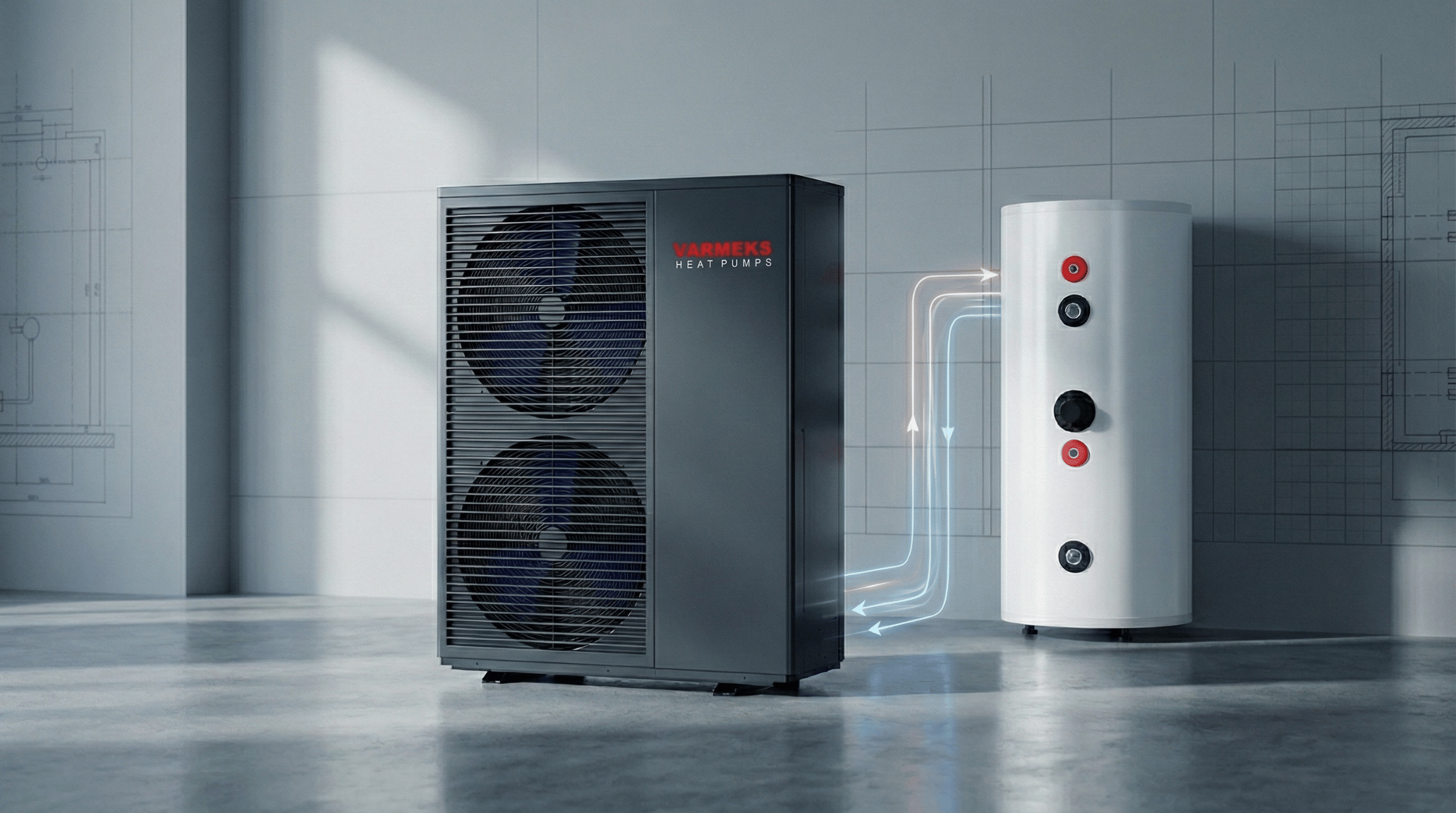
Heat pump systems are at the core of modern heating and cooling solutions due to their high energy efficiency and low operating costs. However, sustaining this efficiency over time depends not only on the performance of the heat pump itself, but also on the correct design and selection of auxiliary system components. Among these components, the buffer tank (hydraulic buffer) plays a particularly critical role.
By stabilizing system operation, a buffer tank enhances overall performance, reduces mechanical stress on the heat pump, and significantly extends the system’s service life.
What Is a Buffer Tank?
A buffer tank is a thermal storage tank that stores hot or cold water produced by the heat pump in a defined volume, ensuring system stability and balance. Its primary function is to create hydraulic separation between the heat pump and the heat distribution system (such as underfloor heating, radiators, or fan-coil units).
By acting as an intermediary, the buffer tank enables the system to respond to sudden heating or cooling demands in a more stable and controlled manner.
One of the most common issues in heat pump systems is frequent start-stop operation over short intervals, known as short cycling. This phenomenon reduces energy efficiency and places significant mechanical stress on system components, particularly the compressor.
By increasing the total water volume in the system, a buffer tank allows the heat pump to operate for longer, more balanced cycles. As a result, short cycling is minimized, system stability improves, and the overall service life of the equipment is extended.
Using a buffer tank allows the thermal energy produced by the heat pump to be utilized more efficiently within the system. Controlled storage of thermal energy prevents the heat pump from operating at full capacity unnecessarily.
This directly contributes to maintaining optimal COP and SCOP values, enabling the same comfort level to be achieved with lower electrical energy consumption under more balanced operating conditions.
In systems equipped with a buffer tank, a certain amount of thermal energy is always readily available. When a heating or cooling demand occurs, the stored energy is immediately supplied to the system.
This feature is particularly beneficial in low-temperature applications such as underfloor heating, where it helps maintain stable indoor temperatures and significantly enhances overall comfort levels.
In heat pump systems where multiple heating circuits operate simultaneously, hydraulic imbalance can easily occur. A buffer tank acts as a hydraulic separator between the production and distribution circuits, allowing the system to operate more reliably.
As a result, flow-rate issues are reduced, system components operate more efficiently, and hydraulic loads within the installation are evenly distributed.
Considering the impact of buffer tanks on overall system performance, correct product design and manufacturing quality are essential. Developed by Solimpeks, Solibuffer buffer tanks are designed to operate in full compatibility with heat pump systems, providing high-efficiency thermal storage solutions.
With a wide range of capacities and connection options, the Solibuffer series offers flexible usage for both residential and commercial applications.
Solibuffer buffer tanks ensure balanced storage and distribution of thermal energy produced by the heat pump. This minimizes energy losses, enhances system stability, and increases overall energy efficiency.
Controlled thermal energy management is particularly advantageous in systems with variable heating demands.
Solibuffer buffer tanks protect heat pumps against frequent start-stop operation, contributing to longer compressor and mechanical component life.
Reduced cycling not only lowers energy consumption but also minimizes long-term maintenance and service costs.
Solibuffer buffer tanks are ideally suited for:
Thanks to their adaptable design, they can be confidently used in a wide variety of system configurations.
With high-density insulation and a design that does not require an anode rod, Solibuffer buffer tanks offer minimum maintenance requirements. This construction ensures long service life while reducing operational costs.
If high efficiency, stable operation, and long service life are the goals of a heat pump system, the use of a buffer tank is essential. A properly selected buffer tank enhances system performance, optimizes energy consumption, and protects the heat pump.
Solimpeks Solibuffer buffer tanks provide a reliable hydraulic balance solution for heat pump systems, combining versatile application compatibility with high quality standards.
A buffer tank provides hydraulic balance in heat pump systems, contributing to more stable system operation.
By balancing the differences between heat generation and heat distribution, it supports efficient and quiet performance.
Especially in applications with variable heating demands, a buffer tank reduces performance losses and helps extend the overall lifespan of the system.
The use of a buffer tank in heat pump systems helps protect the compressor by reducing frequent on–off cycling. As a result, energy consumption is stabilized, maintenance requirements are reduced, and the system operates with a longer service life.
Proper buffer tank selection ensures efficient and comfortable operation while supporting more stable and reliable performance of system components.