
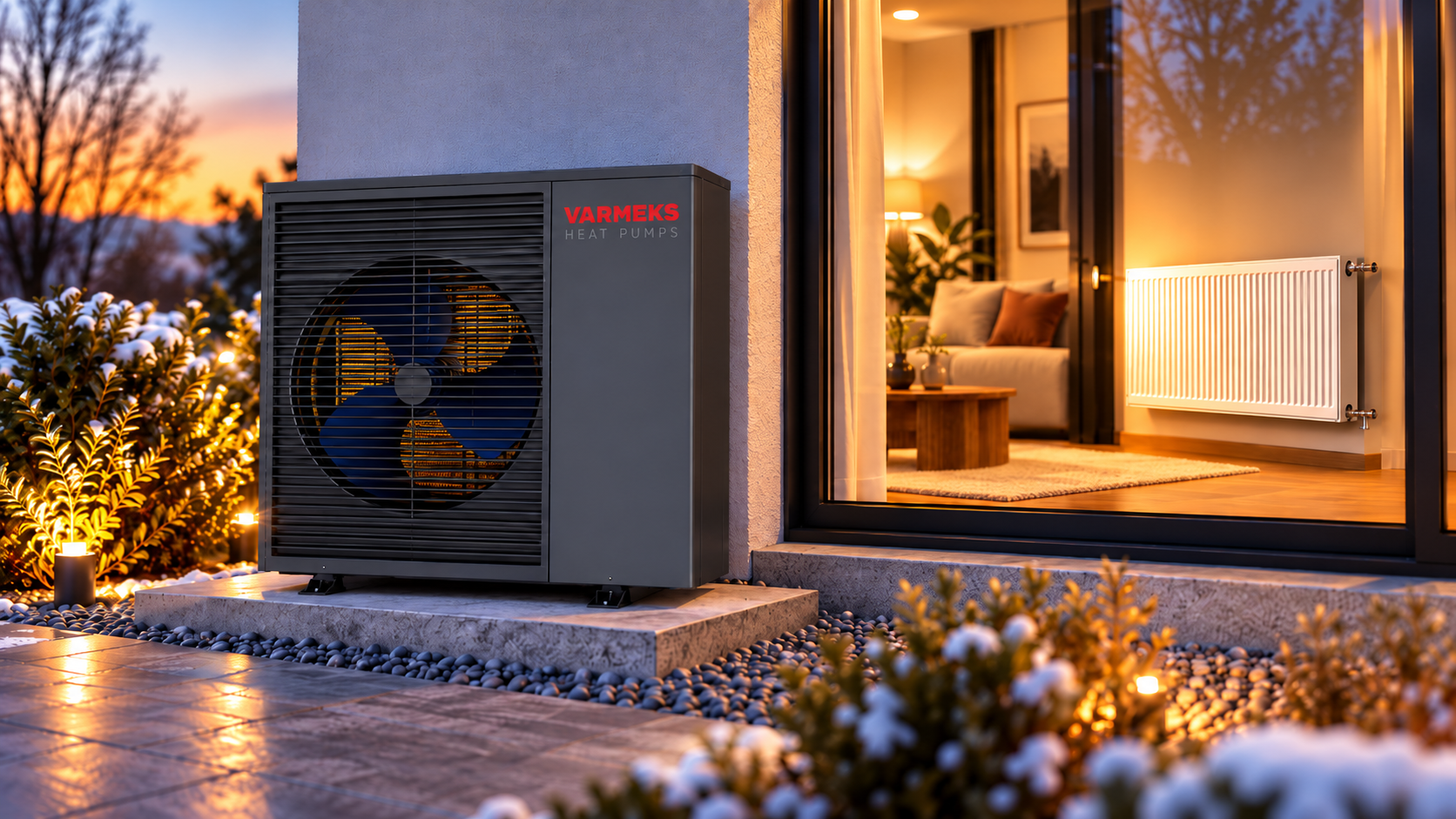
Heat pumps can work with existing radiators. Learn when radiator upgrades are needed, which water temperatures are suitable, and what to consider when switching from a combi boiler to a heat pump.
Can a heat pump work with existing radiators? Yes, air source heat pumps can be used with radiator-based heating systems. However, to ensure efficient and comfortable heating, the capacity of the existing radiators, the building’s heat loss, and the water temperature required by the system must be properly assessed. In some buildings, the existing radiators can be retained, while others may require larger radiators or a heat pump capable of delivering higher water temperatures.
For homeowners and villa owners considering replacing their existing combi boiler system with a heat pump, the key considerations are whether the existing heating installation can be reused and how effectively the new system will perform.
In this guide, we explore how heat pumps work with radiators, suitable water temperatures, when radiator replacement may be necessary, and how selecting the right system affects energy consumption.
A heat pump transfers heat energy extracted from the outdoor environment to the heating system through a refrigerant cycle. The heat is transferred to the water circulating through the heating system and distributed to living spaces via radiators.
Thanks to this operating principle, heat pumps can be used not only with underfloor heating systems but also in homes equipped with traditional panel radiators.
However, there is an important difference between conventional boilers and heat pumps: Heat pumps generally operate more efficiently at lower water temperatures.
Traditional radiator systems may have been designed to operate at higher water temperatures. To achieve the same level of indoor comfort with a heat pump, the radiators must be capable of delivering sufficient heat at lower water temperatures.
Therefore, the compatibility of a radiator system with a heat pump depends not only on the presence of radiators but also on the heating capacity of the existing radiator surfaces.
The water temperature used in heat pump systems is determined by the building’s insulation, outdoor weather conditions, radiator sizes, and the technical specifications of the selected unit.
The following are example temperature ranges for different heat distribution systems:
Heating systemTypical flow water temperatureUnderfloor heating30–35°CRadiators suitable for low-temperature operation40–45°CExisting panel radiators45–55°CRadiator systems requiring higher temperatures55°C and above
These values are general design examples and are not fixed operating temperatures applicable to every building. Actual temperatures should be determined based on heat loss calculations and radiator capacity.
For example, a well-insulated home with sufficiently large radiators may be comfortably heated with a flow water temperature of 45°C. However, the same temperature may not be sufficient in a building with higher heat losses.
The key point to understand is that the maximum water temperature a heat pump can produce is not necessarily the temperature at which it operates most efficiently.
Therefore, the system should be designed to operate at the lowest possible water temperature while still meeting the building’s heating requirements.
No, it is not necessary to replace all the radiators in a home when installing a heat pump.
The need for radiator replacement is determined by comparing the heat loss of each room with the heating capacity that the existing radiators can provide at lower water temperatures.
it may be possible to use a heat pump without replacing all or some of the existing radiators.
Small or single-panel radiators may not provide sufficient heat output at lower water temperatures. In such cases, replacing them with larger radiators or multi-panel models may be considered.
For example, replacing an existing single-panel radiator with a suitably sized double-panel radiator can help achieve higher heat output without significantly increasing the wall space required.
However, the correct approach is not to replace all radiators, but to assess each room individually.
Consider a radiator that provides a heat output of 1,500 W under standard ΔT50 conditions.
Operating conditionsApproximate heat output75°C flow / 65°C return / 20°C room1,500 W55°C flow / 45°C return / 20°C room770 W
When the water temperature decreases, the amount of heat the same radiator can deliver to the room also decreases. The second value in this example was calculated using an approximate temperature correction factor for radiators.
This does not mean that heat pumps cannot operate with radiators. It demonstrates that a larger radiator surface area may be required to meet the same heating demand at lower water temperatures.
This is an example calculation. Actual radiator capacity should be verified using manufacturer data and the temperature correction factors applicable to the specific model.
Yes. A home with an existing combi boiler can be converted to an air source heat pump system when the technical conditions are suitable. Installing underfloor heating or replacing the entire heating system is not always necessary.
However, the existing installation must be assessed.
The first step is to determine the heating capacity required by the home during cold weather conditions.
This calculation considers the building's floor area, insulation characteristics, windows, external walls, and local climate conditions.
The heating demand of each room must be compared with the heat output that the existing radiators can provide at the planned water temperature.
For radiators with insufficient capacity, larger panels, additional radiators, or another suitable heat distribution solution may be considered.
In heat pump applications, pipe diameters, system cleanliness, water flow rate, pressure losses, and circulation conditions are important.
Whether the existing combi boiler installation can be reused depends on its compatibility with the requirements of the selected heat pump.
The capacity of the selected unit should not be determined solely by the home's floor area. The building's calculated heat loss, design outdoor temperature, and required flow water temperature must be evaluated together.
For more information, see our guide: How to Choose the Right Heat Pump Capacity?
High-temperature heat pumps can offer an important alternative, particularly in buildings where the capacity of the existing radiators is limited.
Since these units can achieve higher flow water temperatures than standard low-temperature applications, they may make it easier to use heat pumps with certain existing radiator systems.
However, the ability to deliver higher water temperatures does not mean that radiators can always be retained without modification.
Operating at higher water temperatures also generally reduces heat pump efficiency. Therefore, where possible, reducing the building's heat loss and improving radiator performance at lower temperatures should be considered first.
The Varmeks Varm Boost Series is a range of monoblock heat pumps using R290 refrigerant.
According to the series' technical specifications, the heating circuit can operate at water temperatures of up to 70°C.
This makes the Varm Boost Series a potential option for suitable residential and villa projects with radiator systems requiring higher water temperatures.
However, when selecting a unit, it is essential to verify that the required heating capacity can be delivered at the target water temperature and under the design outdoor conditions.
The Varmeks Varm Up Series offers monoblock heat pump solutions developed with R32 refrigerant and DC inverter technology.
According to the series' technical specifications, it can achieve outlet water temperatures of up to 58°C for heating.
The Varm Up Series can be considered for heating systems capable of operating at low or medium temperatures, particularly in buildings with sufficient radiator surface area and suitable installation conditions.
For both series, the correct product selection should be based on the building's heat loss and the characteristics of the existing heating system.
One of the most important factors affecting heat pump efficiency is the heating water temperature.
As the flow water temperature increases, the temperature lift required from the compressor generally becomes greater. This can increase electricity consumption.
The published seasonal performance data for the Varmeks Varm Boost 8 kW model under EN 14825 average climate conditions are as follows:
Tested outlet water temperatureSCOP35°C4.6455°C3.48
SCOP (Seasonal Coefficient of Performance) represents the heating performance of a unit under standardized seasonal operating conditions.
These values demonstrate why lower water temperatures are advantageous in terms of seasonal efficiency. However, actual electricity consumption varies depending on the local climate, building heating load, usage patterns, and system design.
The following measures are important for an efficient radiator-based heat pump system:
Heat pump systems can operate at lower water temperatures and with more consistent operation than conventional combi boilers. Therefore, radiators not feeling particularly hot to the touch does not necessarily indicate insufficient heating. What matters is maintaining the target room temperature.
Traditional panel radiators used for heating are generally not suitable for active cooling with a heat pump.
Circulating cold water through standard radiators may cause condensation and moisture-related problems if the radiator surface temperature falls below the room's dew point temperature.
For projects where cooling with a heat pump is planned, suitable fan coil units or another appropriate cooling system should be used.
Therefore, the fact that a heat pump can provide both heating and cooling does not mean that existing radiators can be used for both functions.
Before installing a heat pump in a home with existing radiators, the following factors should be technically assessed:
In some projects, a buffer tank may also be considered to meet hydraulic requirements and improve system stability. For more information, see our article: Why Is a Buffer Tank Important in Heat Pump Systems?
Yes. Air source heat pumps can heat traditional panel radiators. However, the radiator capacity and water temperature must be compatible with the building's heat loss.
No. Existing radiators can be used if they provide sufficient heat output at lower water temperatures. Radiators with insufficient capacity may need to be replaced or upgraded to larger models.
Yes. A properly designed radiator-based heating system can heat a home with a flow water temperature of 50°C. Whether this is sufficient depends on the building's heat loss, radiator surface area, and outdoor weather conditions.
An existing combi boiler installation can be reused in some projects. However, before connecting a heat pump, pipe diameters, water flow rate, radiator capacity, and the system's hydraulic requirements must be checked.
Yes. Underfloor heating is not essential for a heat pump. Efficient heating can also be achieved with sufficiently sized radiators or other suitable water-based heat distribution systems.
For the same unit under similar operating conditions, a higher flow water temperature generally results in greater electricity consumption. However, actual consumption depends on the unit's performance, climate, and the building's heating demand.
Yes. Heat pumps can also be installed in older buildings. However, additional improvements may be necessary due to inadequate insulation, existing radiator capacity, or installation conditions.
Installing a heat pump does not always require switching to underfloor heating or replacing all existing radiators.
A properly designed heat pump system can provide comfortable and efficient heating with existing radiators of sufficient capacity.
The key factor is not simply the maximum temperature the unit can produce, but the water temperature required to meet the building's heating demand.
Varmeks offers monoblock heat pump solutions for different temperature and capacity requirements through its Varm Up and Varm Boost Series.
Contact Varmeks to assess whether your existing radiators are suitable for a heat pump and to find the right solution for your project.
Technical note: This content is provided for general informational purposes. Final heat pump and radiator selection must be verified through project-specific engineering calculations.